
Enterprise (on-premises) data centres
Owned and run by the organisation itself, from a server room to a purpose-built hall: the most control, and the most responsibility for power, cooling, security and staff.


Last reviewed: September 2026
A data centre is a secure facility that houses servers, storage and network equipment with the power, cooling and connections to keep them running. This guide explains how organisations choose a data centre in South Africa, comparing colocation, cloud and on-premises options, costs and risks. Arke Technologies designs and manages systems in all three from Johannesburg.
Last reviewed: September 2026 · , 17 min read
A data centre is a building, or a dedicated room inside one, designed to run computing equipment around the clock. It gives servers what an ordinary office cannot give them reliably: clean, backed-up power; cooling that removes the heat they produce; connections to network carriers and the internet; and physical security that keeps out anyone without a reason to be there.
What are data centres used for? Almost everything an organisation runs beyond the laptop: finance and ERP systems, file and email servers, websites and citizen or customer portals, databases, backups and, increasingly, AI models. Every cloud service runs in someone's data centre, so the real question is whose, and for which systems.
Which spelling is right? "Data centre" is the British and South African form. American English ends the word in "-er", and Microsoft writes it as one word in the name of its Windows Server Datacenter edition. All three spellings name the same thing. This guide is one of our insights on IT infrastructure.
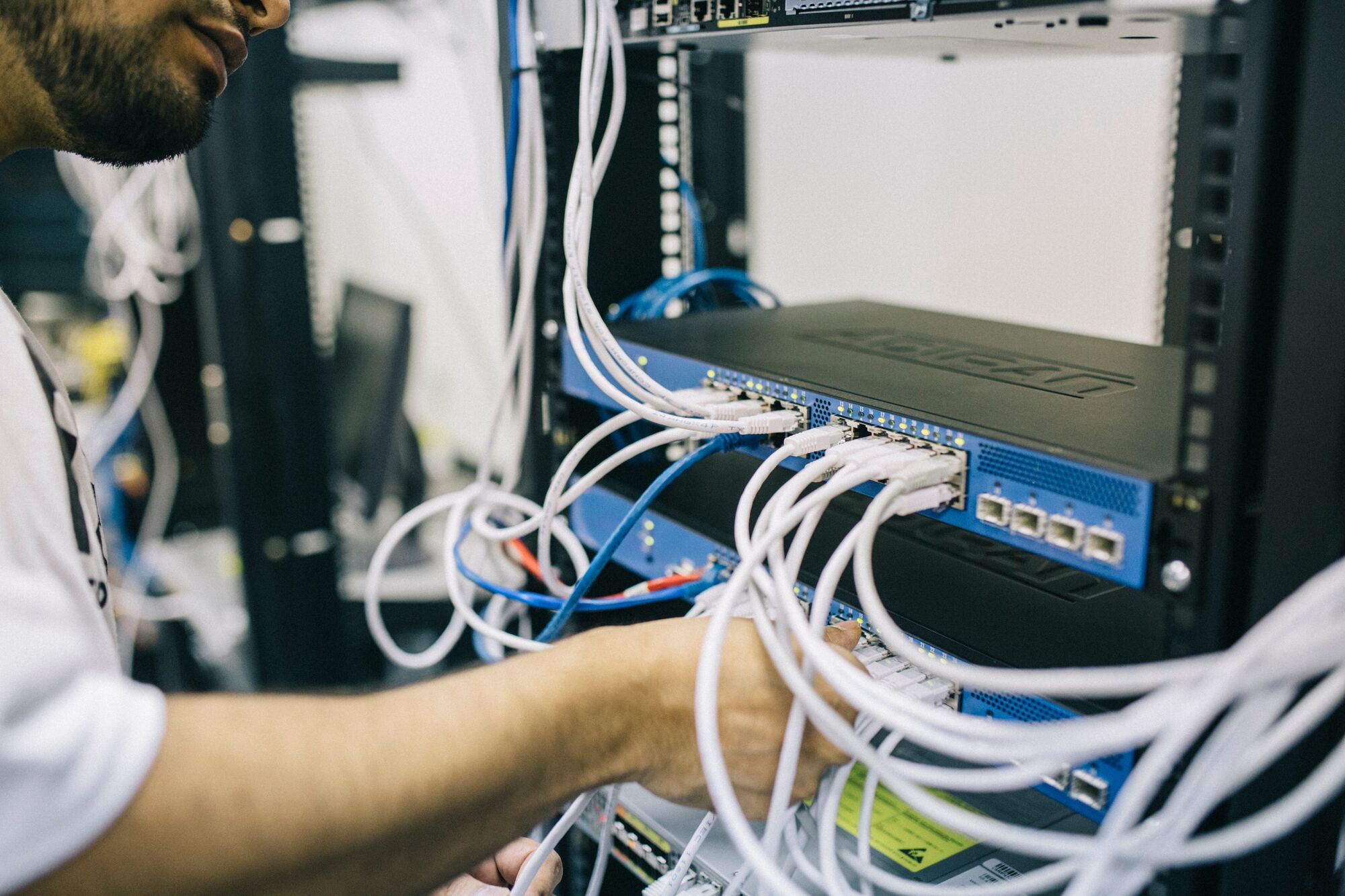
Data centre infrastructure, often shortened to "infra", has two layers: the facility, which the building provides, and the IT infrastructure that the owner or the tenants install.
Four types cover most of the market, and most organisations use more than one.
Owned and run by the organisation itself, from a server room to a purpose-built hall: the most control, and the most responsibility for power, cooling, security and staff.
You rent space, power and cooling and install your own servers. The operator runs the building; you own and manage the equipment.
The very large facilities behind cloud platforms such as Amazon Web Services, Microsoft Azure and Google Cloud, where the building, power, cooling and many thousands of servers are designed and run together, as if the whole data centre were a single computer, and capacity is rented out as cloud services.
Small facilities close to where data is created, down to a micro data centre: a self-contained cabinet with its own power, cooling and fire protection at a mine, factory, hospital or branch. Modular data centres, built in prefabricated units or shipping containers, apply the same idea at a larger scale.
Two more terms cut across these types. A virtual data centre is a pool of virtual servers, storage and networking that a provider runs and you manage as if it were your own. An AI data centre is a facility, or a hall within one, built for the power and cooling that GPU servers need, which is far more per rack than ordinary servers draw.
South Africa has a substantial data centre market. Most capacity sits in Gauteng, around Johannesburg and Midrand, and in the Western Cape, around Cape Town, with smaller facilities in Durban and other cities. The largest campuses are measured by the megawatts they can deliver to IT equipment rather than by floor space, and the ranking changes as new halls open, so which is the biggest data centre in South Africa matters less than whether a facility has the power, resilience and connections your systems need.
All three big hyperscale cloud providers run local regions: Microsoft Azure in Johannesburg, with Cape Town as its paired region; AWS in Cape Town; and Google Cloud in Johannesburg. So if you are asking whether there is a Microsoft data centre in South Africa, or a Google or Amazon one, the answer is yes: these regions let organisations use cloud services while keeping data in the country. Carrier-neutral colocation campuses host many of the country's networks, and South Africa's internet exchange points, where networks swap local traffic directly instead of routing it abroad and back, are housed in data centres in the main metros.
Three local factors shape every decision:
Organisations that work across the continent often choose one data centre in Africa as the hub for several countries, subject to each country's data laws.
What is data centre colocation? It is renting space in a data centre that someone else operates, for servers and network equipment you own. That is what colocation means in a data centre: the operator provides the building, power, cooling, security and access to carriers, and you provide and manage the hardware, operating systems and applications. Colocation, often shortened to colo, is the middle ground between your own server room and the cloud.
What you rent for colocation in a data centre:
What are colocation data centres best for? Steady workloads on hardware you own, systems that must stay in South Africa, and equipment that needs better power, cooling and security than your building provides. You avoid the capital cost of building a room to that standard, but you still buy, maintain and eventually replace every machine inside it.
| On-premises server room | Colocation | Cloud (public cloud or virtual data centre) | |
|---|---|---|---|
| What you own | Hardware, room, power and cooling | The hardware; the operator owns the facility | Nothing physical; you rent capacity |
| Capital cost | Highest: hardware plus room, UPS, generator and cooling | Hardware only | None up front |
| Running cost | Electricity, fuel, maintenance and staff time | Monthly space, power and cross-connects | Usage: compute, storage and data transfer |
| Resilience | As good as your room, UPS and generator | Built to the facility's tier rating | Built into the platform, if you design across zones or regions |
| Scaling | Buy more hardware | Rent more space and power, and buy hardware | Add capacity in minutes |
| Best for | Systems that must sit on site, and small estates | Steady workloads on owned hardware | Variable workloads, new applications, disaster recovery |
| Watch for | Load-shedding, heat and physical security | Power limits per cabinet, contract terms, access logistics | Data transfer fees, cost sprawl, skills |
Private cloud vs data centre is a false choice: a private cloud is a way of running infrastructure, not a place. Virtualised, self-service infrastructure dedicated to one organisation can sit in your own server room, in colocation or with a hosting provider. Most organisations end up hybrid, running some workloads in a public cloud, in effect a cloud-based data centre rented by use, and others on-premises or in colocation, chosen workload by workload; our guide to cloud computing explains the cloud side.
Facilities describe their resilience with the Uptime Institute's Tier Classification, and some use the similar Rated-1 to Rated-4 scale of the ANSI/TIA-942 standard.
| Tier | Name | What it means in practice |
|---|---|---|
| Tier I | Basic capacity | A single path for power and cooling and no redundant components; maintenance means downtime |
| Tier II | Redundant capacity components | Spare UPS, generator and cooling units, but a single distribution path |
| Tier III | Concurrently maintainable | Any component or path can be taken out for maintenance without shutting down IT equipment |
| Tier IV | Fault tolerant | Withstands any single failure, of a component or a path, without affecting IT equipment |
A tier 3 data centre, also written Tier III or tier three, suits most business-critical systems, because planned maintenance no longer means planned downtime; Tier IV is for systems where even a single failure must not interrupt service. Ask whether a rating covers the design, the constructed facility or its operation, since each is assessed separately, and ask to see the certificate.
Last reviewed: September 2026
Data centre colocation pricing, cloud bills and the cost of a server room are built differently, so compare them over the same three- to five-year term.
We do not publish colocation or cloud prices, because they depend on the facility, the power you commit, your usage and the term. Hardware for on-premises and colocated systems is quoted in rand, VAT included, by Server Hub (opens serverhub.co.za), our trading division, and we set out the options for your workloads in writing.
01.
Which systems are critical, which hold personal information, and how long each can be down.
02.
On-premises, colocation, cloud or a mix.
03.
Near your users for the primary site, and far enough away for recovery; Johannesburg and Cape Town are the usual pair.
04.
The tier rating, generator runtime and cooling redundancy that each workload justifies.
05.
The carriers present, cross-connect charges, cloud on-ramps and access to an internet exchange point.
06.
The scope of the facility's ISO/IEC 27001 certificate, access control, CCTV retention, and, where the provider processes personal information for you, a written operator agreement as POPIA section 21 requires.
07.
Power pricing, escalation, remote-hands rates, notice periods and help with exit.
08.
Walk the data hall, the generator yard and the meet-me room before you commit.
We do not own or operate a data centre. We help you decide where each system should run, then design, build, place and manage it from Johannesburg, under one contract with one accountable team.
Every engagement follows the same path: discovery, an assessment of what you run, a written proposal, then an SLA and onboarding. To start, discuss your project with us.
Server Hub, our trading division, supplies the hardware a colocation cabinet or server room holds. Every unit is configured and bench-tested before dispatch, priced in rand with VAT included, and carries a local warranty: 12 months on new and certified refurbished, 90 days on pre-owned, in addition to your Consumer Protection Act rights.
Servers (opens serverhub.co.za) and rack servers (opens serverhub.co.za) for virtualisation hosts, databases and file services.
for steady workloads, test environments and recovery sites.
Storage (opens serverhub.co.za) and NAS (opens serverhub.co.za) for files, virtual machines and backups.
Last reviewed: September 2026 · , 17 min read
Map your systems to the right data centre
Tell us what you run and where your users are, and we will set out the on-premises, colocation and cloud options, with costs over the term.
Discuss your projectPlain, sourced guides for the people who decide on and buy technology, sent to your inbox.
Yes. South Africa has a substantial data centre market, with most capacity in Gauteng, around Johannesburg and Midrand, and in the Western Cape, around Cape Town. It includes large colocation campuses, enterprise facilities and the local cloud regions of Microsoft Azure, AWS and Google Cloud, so organisations can keep their data in the country.
The biggest data centre providers are the hyperscale cloud platforms, Amazon Web Services, Microsoft Azure and Google Cloud, alongside large colocation operators that rent space and power to many tenants. In South Africa, all three hyperscalers run local cloud regions, and the large colocation campuses cluster around Johannesburg and Cape Town. Compare facilities on power, resilience and connectivity rather than size; we help clients make that comparison and place their equipment.
A data centre provides space, power, cooling, network connectivity and physical security for computing equipment. Colocation facilities add cross-connects to carriers and clouds, remote hands and monitoring; cloud and managed data centres add rented servers, storage, backup and disaster recovery. Together these let an organisation run systems around the clock without building its own facility.
The four main types are enterprise (on-premises), colocation, hyperscale or cloud, and edge data centres. Enterprise facilities are owned and run by one organisation; colocation facilities rent space and power to many; hyperscale facilities deliver cloud services at vast scale; and edge facilities are small sites close to users or machines. Modular designs can serve any of these roles.
Colocation in a data centre means renting space, power and cooling in a facility someone else operates, for servers and network equipment you own. The operator runs the building, security and carrier connections; you run the hardware and software. It suits steady workloads on owned hardware, and data that must stay in South Africa, when your own building cannot give servers the power, cooling and security they need.
The biggest use of data centres is running the applications, websites and data that organisations and online services depend on, most of it now delivered as cloud services. Data centres also hold backups and disaster recovery copies, and AI workloads increasingly shape how new facilities are designed, because GPU servers need much denser power and cooling than ordinary servers.
A tier 3 data centre is concurrently maintainable: any component, or any power and cooling path, can be taken out of service for maintenance without shutting down the IT equipment. It is the third of the Uptime Institute's four tiers and suits most business-critical systems. Tier IV adds fault tolerance, surviving any single failure without affecting IT equipment.
Tell us what you run and where your users are, and we will set out the on-premises, colocation and cloud options, with costs over the term.